

The loom, defined on its own terms
A reference shelf, not a feed: the words, tools, techniques and history behind everything the shop sells. Undated on purpose — entries are corrected in place and stay linkable forever.
Terminology
The words the loom shed actually uses, defined the way the shed uses them.
- Warp and weft#warp-weft
The warp is the set of threads held taut along the loom's length; the weft is the thread the shuttle carries across them. Every woven structure, however ornate, is a rule for which of the two shows.
- Pallu#pallu
The saree's display end — the last metre or so, worn over the shoulder, where the weaver concentrates the richest work. In this catalogue the pallu is where Gollabhama figures walk and Gadwal zari sits deepest.
- Selvedge#selvedge
The self-finished edge of the cloth, where the weft turns back. A hand loom's selvedge carries the evidence: slight, regular variation that a powerloom cannot counterfeit.
- Zari#zari
Metallic thread — traditionally silver-gilt wound on silk — used for borders and motifs. The older Gadwal proportion keeps zari to a narrow line inside the colour rather than flooding the border with it.
- Loom days#loom-days
The unit this whole site counts in: days a piece actually spends on the beam. It is printed on every product card because time is the honest price of handloom, and the one figure a powerloom cannot copy.
Tools
The objects between the yarn and the cloth. None of them has changed much in a century, because none of them has needed to.
- The pit loom#pit-loom
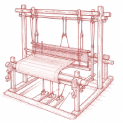
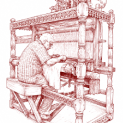
A frame loom set over a shallow pit that holds the treadles, putting the weaver at floor level with the cloth. Most of the catalogue is woven on pit looms older than their weavers.
The pit is not nostalgia: it keeps humidity at the shed's floor, which cotton warp likes, and it lets the loom's frame be lighter because the ground does the bracing.
- Shuttle#shuttle
The boat-shaped carrier that takes the weft through the open shed of the warp. Its pass-and-return is the tick of the loom's clock — listen to any of the films and you are hearing the shuttle.
- Reed#reed
The comb that spaces the warp and beats each new pick of weft into place. Reed count — threads per inch — is the cluster's accent: Narayanpet's checks and Nalgonda's checks differ first of all in the reed.
- Treadles#treadle
The foot pedals that raise and lower sets of warp threads. The weaver's feet run the structure while the hands run the pattern; watching both at once is watching two instruments played together.
- The extra-weft spool#spool
A small hand-held spool, one per motif, used to lay supplementary thread only where a figure needs it. Siddipet's Gollabhama figures each get their own — no jacquard, no carrying the thread across the back.
Techniques
What the clusters in the catalogue actually do — the same names the filter rail uses.
- Resist-dyed ikat#ikat
The pattern is tied into the yarn and dyed before weaving begins, so the motif arrives already inside the thread. Its soft edges are not blur but the technique's signature.
Pochampally works both single ikat (warp or weft patterned) and the far harder double ikat, where both are dyed and must land in register on the loom.
- Kupadam interlock#kupadam
Gadwal's join: the silk border warp and cotton body warp are interlocked thread by thread at the meeting line, making border and body structurally one cloth. Pull the border and the body answers.
- Extra-weft figures#extra-weft
Supplementary weft laid in by hand, existing only where the motif is. Each Siddipet milkmaid is built this way, pick by pick, from her own spool — which is why no two figures in a row are quite identical.
- The temple border#temple-border
A border of counted triangles climbing the selvedge, worked as interlocked tapestry. The triangles are counted in the body, not measured — see the field note on Narayanpet for what that sounds like.
- Reading a check pattern#checks
Checks are the loom's own audit: any unevenness of beat or tension shows as a rectangle where a square should be. Clusters that weave checks — Nalgonda, Narayanpet — are advertising that they have nothing to hide.
History
How the cloth got here. Evergreen by intent: these entries are corrected, never re-dated.
- Handloom and powerloom, seen up close#handloom-and-powerloom
The two are not fast and slow versions of one thing; they are different objects. The powerloom repeats a decision once made; the handloom makes the decision continuously, which is why its cloth carries variation the way a voice carries tone.
The practical tell: turn the cloth over. Hand-laid extra weft is finished on the back; a machine copy carries floats or is printed. The library exists so a buyer can check this in a shop with the seller watching.
- Why "Bhoodan" Pochampally#bhoodan
The town's full name remembers the Bhoodan movement: in 1951 it was the first village where land was voluntarily gifted to the landless. The weaving cluster and the name have grown together since.
- Six objects every handloom story begins with#six-objects
Warp, weft, shuttle, reed, treadle, spool. Every technique in this library is a different grammar for the same six objects — which is why a weaver from one cluster can read another cluster's cloth at a glance, the way musicians read each other's scores.