


Processes
How the techniques actually work, step by step, with the tools each step turns on. Read these and the prices in the shop start explaining themselves.
Practised at Bhoodan Pochampally, Nizamabad, Adilabad
How ikat resist-dye works
Ikat decides the pattern before the loom is involved: bundles of yarn are tied where the dye must not reach, dyed, retied and dyed again. The weaving only reveals a decision that was made weeks earlier at the tying frame.
01
The yarn is wound into counted groups
Warp threads are stretched on a frame and divided into groups, each group standing for one column of the final pattern. The counting is the craft — a miscount here arrives on the loom as a motif that misses itself by a thread.
Tool · Warping frame
02
The pattern is tied on, knot by knot
Wherever the cloth must stay undyed, the group is bound tightly with rubber or cotton ties. The tyer works from a chart or from memory, marking dozens of wraps per metre. In double ikat, warp and weft are both tied — and must meet on the loom.
Tool · Threading needle
03
Dye, dry, retie, dye again
The bundles go into the dye pit; the ties resist it. For each additional colour, old ties come off, new ties go on, and the yarn is dyed again — darkest last. A three-colour ikat has been tied and untied hundreds of times before it is thread on a loom.
04
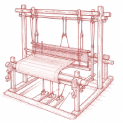
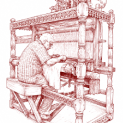
The loom lines the pattern up
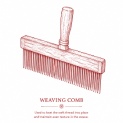
Dyed yarn is dressed onto the loom in its original counted order. As the weaver beats each pick in, the softened edges of the resist meet — the slight feathering where colours join is the signature of ikat, not a flaw in it.
Tool · Weaving comb
Practised at Jogulamba Gadwal
How a Gadwal border is joined
A Gadwal saree is two cloths woven as one: a light cotton body and a silk border, interlocked thread by thread at the join while both are on the loom. The seam is structural — kupadam — which is why it cannot be pulled apart.
01
Two warps are dressed side by side
The loom carries the cotton body warp and the silk border warp as neighbours, each with its own tension. Dressing them evenly is a two-person job: some ten thousand cotton ends and the silk beside them, counted through the reed.
Tool · Warping frame
02
The wefts interlock at the boundary
At every pick, the body weft and the border weft meet at the join and loop around each other before turning back. This is the kupadam interlock — done by hand at the selvedge, pick after pick, for the full length of the saree.
03
The korvai discipline holds the line
The join must run straight for six metres. The weaver watches the boundary constantly; a drifting join is visible from across a room and cannot be corrected after the fact. Eighteen to thirty days of never letting it wander.
Tool · Measuring scale
04
The pallu is woven last, planned first
The heavy silk pallu was planned before the warp was wound — its zari counted into the order of threads. The border's silk turns and floods the full width, and the cotton body ends where the ceremony begins.
Practised at Siddipet
How the Gollabhama figure is carried
Siddipet's milkmaid motif is not printed and not jacquard-lifted. Each figure is laid into the cloth in extra weft — a supplementary thread carried by its own small spool, worked figure by figure across the pallu by hand.
01
The figure is charted on paper
The motif lives as a thread-count chart, often inherited: so many ends across the shoulder, so many picks down the pot she carries. Weavers keep these folded in the loom bench and correct each other's from memory.
02
A spool per figure, laid by hand
At each repeat the weaver stops the ground weave, picks up a small spool of contrast thread, and floats it over and under counted warp ends to build one row of the figure. Every figure in the row gets its own spool before the next ground pick.
Tool · Threading needle
03
Row by row, the milkmaid stands up
The figure rises one pick at a time over dozens of rows. An error is not patched — the rows come out and are relaid. A full pallu of figures is around a month of this, which is why the technique survives on only a handful of looms.
Tool · Weaving comb
04
The ground closes over the floats
Between figures the extra weft is carried invisibly or trimmed, and the plain ground is beaten firm around each motif. Done right, the figure reads as part of the cloth's structure — because it is.